
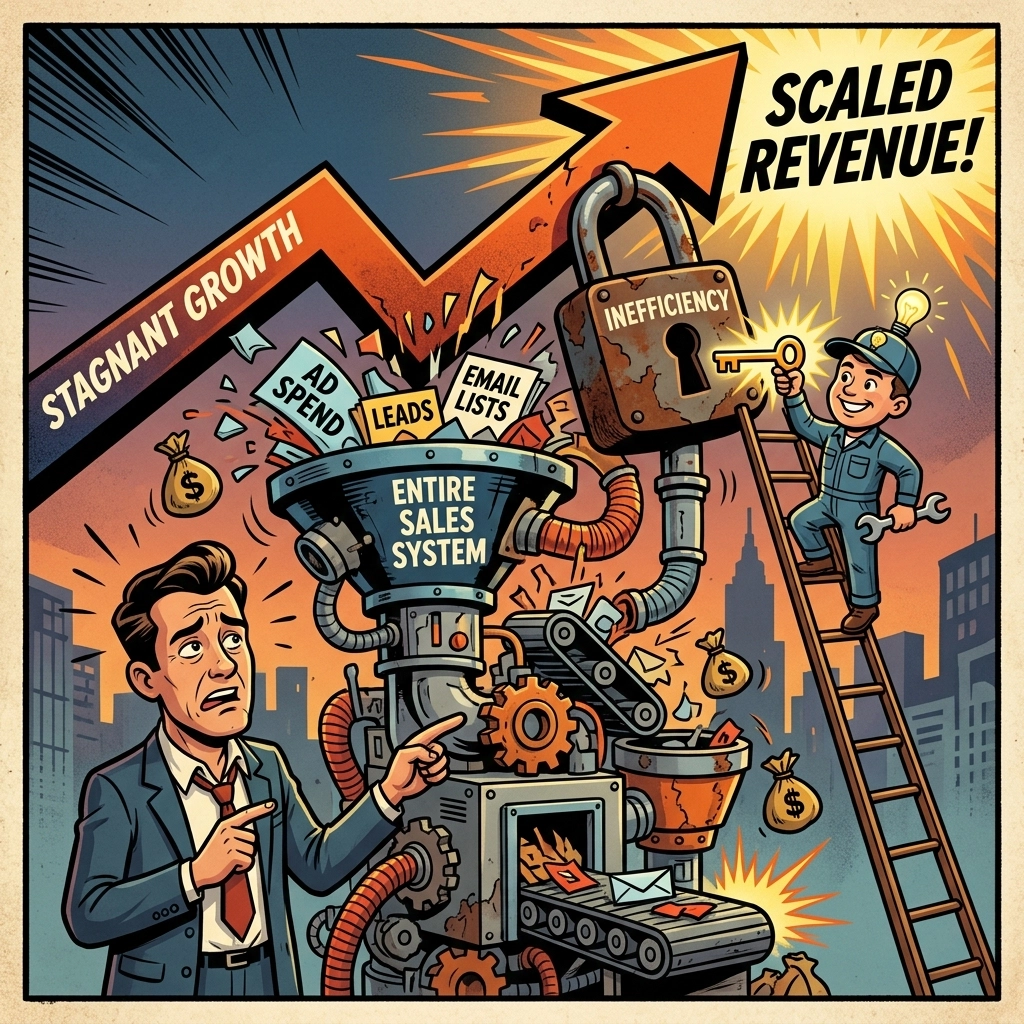
10 Reasons Your Digital Marketing Isn’t Scaling (And How to Fix Your Entire Sales System Right Now)
You’ve been there, haven’t you, Peter? You see the traffic numbers going up, you’re cutting checks to Google and Meta every month, but the actual revenue growth feels like it’s stuck in a perpetual Vancouver traffic jam on the Lions Gate Bridge. You’re pushing the pedal down, but the car isn’t going any faster.
In 2026, the digital marketing landscape has shifted. The "hacks" that worked two years ago are now the quickest way to burn through your budget. If you feel like your scaling efforts have hit a brick wall, it’s usually not because your ads are "bad": it’s because your entire sales system is misaligned.
Here are the 10 real reasons your digital marketing isn't scaling and, more importantly, how you can fix the engine today.
1. You’re Chasing Tactics, Not a Strategy
Most SMBs in the Fraser Valley are guilty of "Tactical Whack-a-Mole." One week it’s TikTok ads, the next it’s SEO, then it’s a random LinkedIn outreach campaign. Without a documented growth framework, you’re just throwing spaghetti at the wall.
Scaling requires a system where every piece: from the first click to the final handshake: works in harmony. If you don't have a proven growth engine framework, you aren't building a business; you're just running a series of expensive experiments.
2. Your "Google Ads Expert" is Only Scaling Branded Search
This is a classic trap. You hire a google ads expert, and they show you a 10x ROAS (Return on Ad Spend). You’re thrilled until you realize that 90% of those sales came from people who were already searching for your company name.
Branded search protects your turf, but it doesn't grow the pie. To scale, you need to capture new demand. This means winning at the top of the funnel with non-branded keywords and high-intent local searches. If your current ppc agency vancouver isn't showing you how they are acquiring new customers who had never heard of you, you aren't scaling: you're just paying a tax on your own reputation.

3. The "Leaky Bucket" Website Syndrome
You can have the best ads in the world, but if your website looks like it was designed in 2018, you’re flushing money down the toilet. In 2026, users expect a frictionless, high-converting experience.
Are you sending traffic to a generic homepage or a high-converting funnel designed to capture leads? Traditional websites are often too cluttered to scale effectively. You need a site that acts as a 24/7 salesperson. If your conversion rate is under 3%, your scaling problem is actually a web design problem.
4. Leads are Dying in Your Inbox
Scaling digital marketing creates a volume of leads that most small teams simply can’t handle. If it takes your team four hours to call a lead back, that lead is already cold.
This is where the gap between marketing and sales becomes a canyon. To fix this, you need a 24/7 response system. Many Vancouver businesses are now turning to AI employees to handle the initial intake. These AI SDRs can engage a lead within seconds, qualify them, and book a meeting on your calendar while your human team focuses on closing.

5. You’re Spreading Your Budget Too Thin
It’s tempting to want to be everywhere: Google, Meta, LinkedIn, YouTube, and local SEO. But for most SMBs, being "okay" on five platforms is worse than being "dominant" on one.
Scaling isn't about breadth; it's about depth. Find the one channel where your unit economics work: where your Customer Acquisition Cost (CAC) is significantly lower than your Lifetime Value (LTV): and pour fuel on that fire until you hit diminishing returns. Only then should you look to diversify.
6. You’ve Ignored the Power of Multi-Touch Sequences
The days of "one click, one sale" are largely over for B2B and high-ticket home services. Your prospects need to see you multiple times across different platforms before they trust you.
If your marketing stops at the click, you’re missing out. You need a multi-touch sequence that combines retargeting ads, automated email follow-ups, and even LinkedIn prospecting. At Quality Lead Generation, we’ve seen conversion rates jump by 75% just by implementing better outbound prospecting.
7. The Anxious Owner vs. The Optimized System
Meet Izzy. Izzy is an overwhelmed business owner in Burnaby. Izzy spends all day worrying about why the phone isn't ringing, but hasn't looked at her CRM data in months.

Scaling requires moving from "founder-led" everything to "system-led" growth. If the system depends on you being in a good mood or having a free hour to check the ads, it won't scale. You need a local outsourced sales team that operates independently of your daily schedule.
8. You Aren’t Utilizing Agentic AI
In 2026, the difference between a business that scales and one that plateaus is how they use AI. We’re not just talking about ChatGPT writing a blog post; we’re talking about Agentic AI: autonomous agents that can research prospects, send personalized messages, and manage your CRM.
By integrating AI employees versus traditional human SDRs, you can reduce your overhead while increasing your output. These "AI Do-ers" don't take vacations and don't get discouraged by "no."

9. Lack of Local Market Context
A generic ppc agency in another country doesn't understand the nuances of the Vancouver market. They don't know that targeting "all of BC" is very different from targeting specific neighborhoods in the Fraser Valley.
Local expertise matters because it informs your messaging. A "Google Ads expert" who knows the local competitive landscape can find the gaps your competitors are missing. Whether it's the specific pain points of a Surrey homeowner or the B2B needs of a Delta logistics firm, local context is the secret sauce to scaling.
10. You’re Not Tracking the Right Metrics
If you’re still talking about "likes," "impressions," or even "clicks," you’re looking at the wrong dashboard. To scale, you must track:
- Cost Per Qualified Lead (CPQL): Not just any lead, but one that can actually buy.
- Sales Velocity: How long it takes to move a lead through your funnel.
- Customer Acquisition Cost (CAC) by Channel: Knowing exactly where to put your next dollar.
If your sales tech stack is messy, your data will be lies. You need a clean CRM setup that links your digital marketing spend directly to closed revenue. If you aren't sure where to start, check out our guide on fixing your sales tech stack.
How to Fix Your Entire Sales System Right Now
Scaling isn't an overnight event; it's an engineering project. If you're ready to stop guessing and start growing, you need to shift from "buying ads" to "building a growth engine."
At Quality Lead Generation, we don't just "do marketing." We build fully managed sales systems that combine the best of Vancouver-based human expertise with cutting-edge AI technology.
Here is your 3-step fix:
- Audit the Funnel: Stop the leaks in your web design.
- Automate the Intake: Use AI SDRs to ensure zero lead lag.
- Outsource the Grind: Let a local team handle the prospecting so you can focus on the vision.
Ready to see how the 2026 Growth Engine can transform your BC business? Let’s build your system together.
