
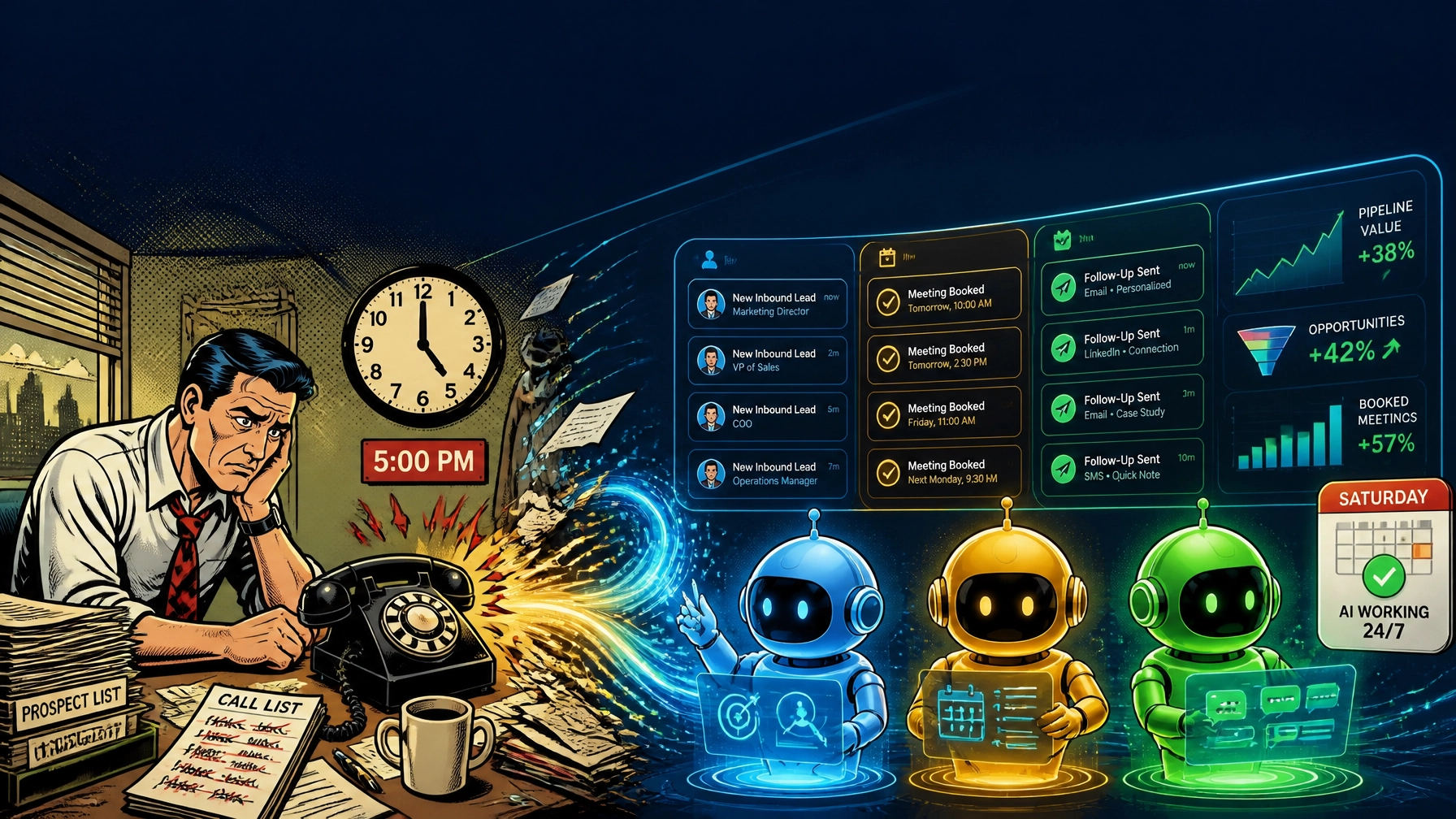
From Cold Calls to AI Do-ers: The Evolution of Sales for SMBs
For decades, small and mid-sized businesses followed the same sales playbook:
Build a prospect list. Pick up the phone. Start dialing. Leave voicemails. Follow up tomorrow. Keep calling until someone answers.
It worked, sometimes.
But it was also expensive, repetitive, difficult to scale, and almost entirely dependent on whether a salesperson was sitting at their desk.
Today, sales is moving from manual cold calls to active, AI-powered execution. Instead of simply generating leads or suggesting what a salesperson should do next, agentic AI “do-ers” can take action. They can identify prospects, qualify inquiries, personalize outreach, nurture conversations, schedule meetings, update a CRM, and help move deals toward the finish line.
For SMB owners across North America, this evolution creates a major opportunity: build a pipeline that keeps working even when the team is busy, the office is closed, or the calendar says Saturday.
The Old Sales Playbook Stopped at 5 p.m.
Traditional sales had a hard boundary.
At 5 p.m., the phones stopped. Salespeople went home. Follow-ups were pushed to Monday. A lead that submitted a form on Saturday night might not hear from the business until the following business day.
That delay can cost real opportunities.
A prospect searching for a contractor, lawyer, clinic, electrician, recycling provider, or B2B service may be ready to act right now. If they do not receive a timely response, they may contact the next business on Google.
The problem was not always a lack of leads. Often, it was a lack of sales capacity.
A digital marketing campaign could generate clicks and form submissions, but somebody still had to:
- Respond to every inquiry
- Ask qualification questions
- Confirm budget, timing, location, and fit
- Answer common questions
- Follow up with people who did not respond
- Book appointments
- Update the CRM
- Prepare the opportunity for a closer
For a small business owner already managing operations, staff, customers, and fulfillment, that is a lot to handle.
This is why the next phase of sales is not simply “more automation.” It is active execution.
From Passive Lead Generation to Active Sales Execution
Traditional automation follows a fixed instruction:
If someone fills out a form, send an email.
An agentic AI do-er can manage a much broader workflow:
If someone fills out a form, review their information, identify their likely need, ask relevant questions, determine whether they fit the service criteria, respond using approved business information, offer an appointment, and alert a human when the opportunity requires personal attention.
That difference is significant.
As Salesforce explains in its overview of agentic AI for small businesses, AI agents can operate with context, make decisions, execute multiple connected tasks, and work within systems such as a CRM.
In practical terms, an AI sales system can become an active layer between your marketing and your sales team.
It does not just tell you that a lead arrived. It helps determine what should happen next, and can often take that next step immediately.

Meet Orion, Atlas, and Vince
Quality Lead Generation’s AI sales ecosystem is built around three specialized AI do-ers. Each one has a clear role in moving prospects through the pipeline.
Orion: Finding the Right Opportunities
Orion is focused on outreach and prospect discovery.
For outbound campaigns, Orion can help identify potential buyers based on your ideal customer profile. That might include industry, location, company size, job title, buying signals, or other criteria that matter to your business.
For a commercial recycling company, that could mean finding facility managers or manufacturers. For a B2B consultant, it might mean identifying founders or marketing directors. For a local service company, it could mean organizing inbound opportunities from a specific service area.
The objective is not to contact everyone. It is to find and connect with the prospects most likely to be a fit.
Atlas: Qualifying and Nurturing Conversations
Atlas helps keep conversations moving.
When a prospect responds, Atlas can ask helpful questions, gather relevant details, and identify whether the person is ready to buy, needs more information, or should enter a longer nurturing sequence.
This is particularly important because not every lead is ready to make a decision immediately. Some are comparing options. Others need internal approval. Some simply become distracted by the demands of running their own business.
Atlas can support consistent follow-up without relying on someone’s memory or availability. It can help answer common questions, share approved information, and recognize when a prospect is showing stronger buying intent.
Vince: Moving Qualified Leads Toward the Close
Vince is focused on engagement, appointment coordination, and closing workflows.
For straightforward offers, Vince can help guide prospects through the next step, address common objections, and make it easy to book a call or consultation. When a conversation becomes complex, sensitive, or high-value, Vince can route it to a human sales professional with the full conversation history attached.
That means the salesperson does not have to begin with, “So, how did you hear about us?”
They can begin with context.
Why Saturday Matters
Saturday is where the difference becomes especially obvious.
The old sales system says, “We will get back to you Monday.”
The AI sales system says, “Let’s respond while the buying intent is still fresh.”
Imagine a homeowner searching for an emergency electrician on Saturday afternoon. A business owner looking for a new marketing partner on Saturday evening. A facility manager submitting a commercial recycling inquiry before the weekend shift ends.
An AI do-er can respond immediately, ask the right questions, confirm the details, and offer an available appointment.
The business owner can enjoy the weekend without leaving every opportunity unattended.

This does not mean every prospect should receive an impersonal message or that humans are no longer important. It means your business can provide fast, useful first contact while reserving human time for the conversations that truly require judgment, trust, and relationship-building.
That combination is powerful:
- AI handles speed and consistency.
- Humans handle nuance and trust.
- The CRM keeps the entire process organized.
- The business keeps moving after hours.
The Role of PPC, Google Ads, and AI Employees
Agentic AI becomes even more valuable when it is connected to high-intent marketing.
A strong campaign managed by a ppc agency vancouver businesses can work with may drive qualified traffic from Google Search, Facebook, Instagram, or YouTube. A google ads expert can help target people who are already searching for a specific product or service.
But paid traffic is only the first step.
If your ads generate leads and those leads sit unanswered for hours, your campaign is not reaching its full potential. Marketing may be doing its job while the sales process creates the bottleneck.
That is where AI employees can help.
They can support the journey from:
- Search or social ad
- Landing page or website visit
- Form submission, call, or chat
- Qualification
- Follow-up
- Appointment booking
- Human sales conversation
- Proposal or purchase
This connects advertising performance to actual sales activity rather than stopping at impressions, clicks, or raw lead counts.
For SMBs, that connection matters. A campaign should not only generate attention. It should help create conversations and revenue.
AI Do-ers Do Not Replace Strategy
There is one important reality: AI cannot rescue a broken sales system by itself.
If your offer is unclear, your audience is poorly defined, your landing page is confusing, or your CRM is full of inaccurate information, an AI agent will have a difficult job.
Successful implementation starts with the basics:
- A clearly defined ideal customer
- A focused offer
- Accurate business and service information
- Qualification rules
- Approved messaging
- A functioning CRM
- Clear human handoff points
- Conversion goals tied to revenue
As Quality Lead Generation’s autonomous sales blueprint explains, the system should be designed around the final business outcome. That might be a booked consultation, paid deposit, signed agreement, or completed purchase.
The technology is important, but the strategy gives it direction.
The New Competitive Advantage Is Execution
The evolution of sales is not really about choosing between humans and machines.
It is about choosing between businesses that execute consistently and businesses that allow opportunities to disappear.
Two companies may receive the same number of leads. One responds during business hours and follows up when someone remembers. The other responds immediately, qualifies every inquiry, nurtures undecided prospects, and keeps working through the weekend.
Over time, that difference compounds.
Cold calling is not disappearing entirely. Personal conversations still matter, and a well-prepared salesperson can be extremely effective. But the old system of manually dialing through lists and waiting until Monday is no longer the only option.
The modern SMB sales system combines human expertise with always-on AI do-ers that can find, engage, qualify, and help close opportunities 24/7.
Your pipeline should not go quiet just because your office does.
Ready to build a sales system that keeps working after 5 p.m.: including Saturday? Explore Quality Lead Generation or book a consultation to see how Orion, Atlas, and Vince can support your next stage of growth.
Categories: AI Sales Automation, Lead Generation, Sales Outsourcing, Digital Marketing
