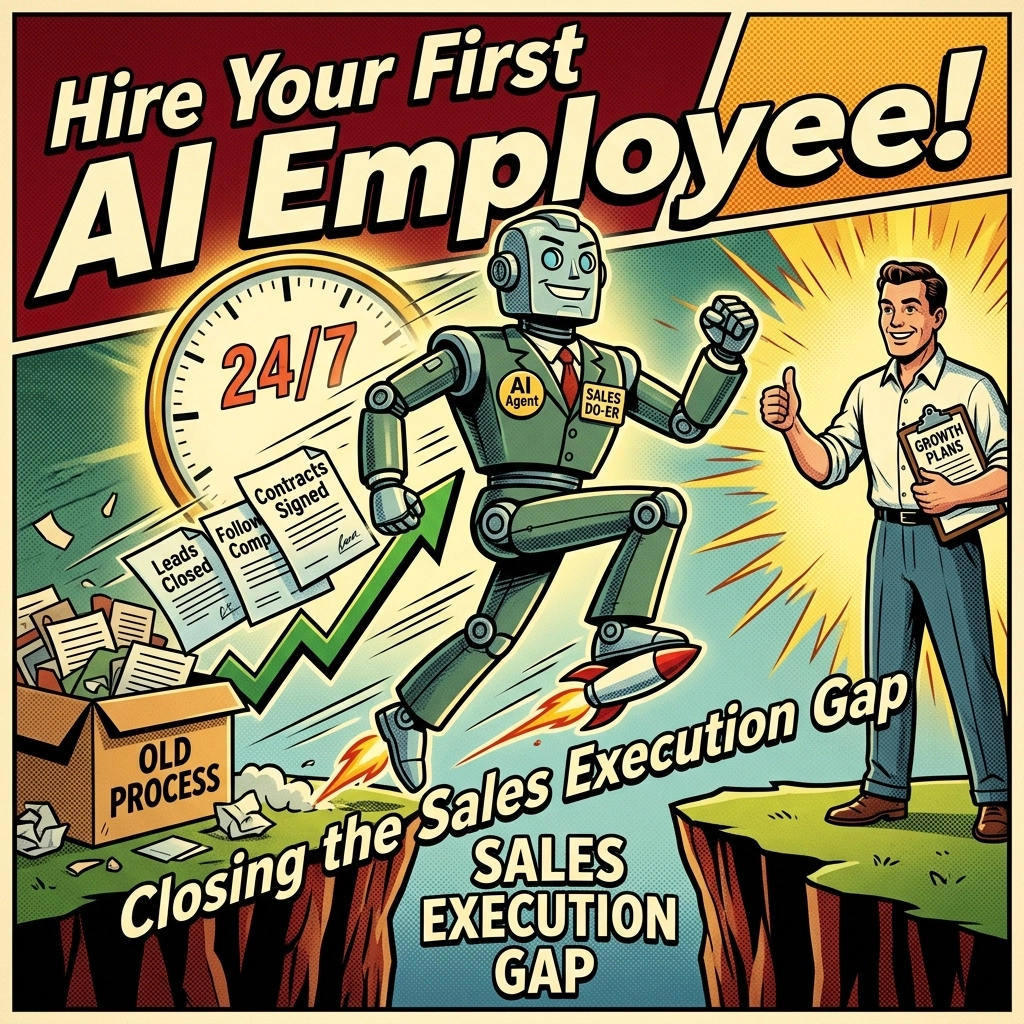
Hire Your First AI Employee: How Agentic AI ‘Do-ers’ Are Closing the Sales Execution Gap

Categories: AI Sales, Sales Outsourcing, Digital Marketing

In April 2026, “lead generation” has officially changed meaning for North American SMBs.

A couple years ago, most companies were trying to answer: How do we get more leads?
Now the winners are answering a different question: How do we execute on every lead, every time, without burning out our team?

That’s the Execution Gap: the space between having demand (ads, referrals, SEO, social) and actually converting it (speed-to-lead, follow-up consistency, qualification, booking, and handoff). It’s where most revenue quietly disappears, especially for busy local businesses in Vancouver, Langley, Surrey, and across the Fraser Valley.

Agentic AI is how SMBs are closing it. Not with “AI that suggests,” but with AI do-ers that take action inside your sales system.


The Execution Gap (and why your CRM isn’t fixing it)

Most SMBs already have some pieces:

  • A website or funnel
  • Google Ads / Meta Ads / Local SEO
  • A CRM (or at least an inbox)
  • A phone that rings
  • A person “following up when they can”

And yet, the same problems keep happening:

  • Leads come in after hours → response is next day (or never)
  • Someone forgets to follow up after the first quote
  • A hot lead sits uncalled because the team is on a job site
  • The calendar stays half empty even when ad spend is high
  • “We’ll call them back” turns into “they went with someone else”

This isn’t a lead problem. It’s an execution problem.

CRMs don’t execute. They store information.
Standard automations don’t execute either. They run pre-set rules until something unexpected happens (which is basically… always in real-world sales).

What’s changed in 2026 is that AI can now operate your system: read context, make decisions, take next steps, and keep moving the deal forward.


“Hire your first AI employee” doesn’t mean replacing humans

Let’s make it simple: your first AI employee shouldn’t be the “closer.” It should be the teammate that makes sure closers never waste time.

Think of agentic AI like a small internal team that:

  • responds instantly,
  • never forgets,
  • works nights/weekends,
  • follows the rules you set,
  • and escalates to a human when it matters.

That last point is the key, and we call it the Human-Agent Handshake:
AI handles the repetitive execution, and humans step in for judgment, empathy, pricing, and negotiation.

If you do this well, you don’t “automate sales.” You build a 24/7 sales execution engine.

![Outsourced Sales Teams Powered by AI


Meet the agentic AI “do-ers”: Orion, Atlas, and Vince

At Quality Lead Generation, we think of agentic AI do-ers as roles, not tools. Here are three AI employee personas that show up again and again in real SMB sales systems.

1) Orion (The Orchestrator): CRM logic + pipeline control

Orion lives in the CRM. This is the AI employee that keeps your sales machine organized and moving:

  • Creates/updates opportunities automatically
  • Tags leads by service, location, urgency, and source
  • Routes leads to the right rep (or the right branch/crew)
  • Triggers sequences based on real behavior (not just “Day 1 / Day 3”)
  • Detects pipeline stalls (“No reply in 48 hours” / “Quote sent, no next step”)
  • Generates daily “what to do next” lists that are actually accurate

Where Orion shines: trades, home services, law firms, clinics, anywhere leads come from multiple channels and humans are too busy to keep the CRM perfect.

Execution Gap closed: “We have a CRM” → “Our CRM runs the business.”


2) Atlas (The Sentinel): research + qualification before your team spends time

Atlas is the guard at the gate, in a good way. It qualifies leads with consistency and does the stuff humans hate doing:

  • Enriches inbound leads (company info, service area, property type, etc.)
  • Confirms fit (budget range, timeline, location, decision maker)
  • Flags spam and low-intent inquiries
  • Scores leads so your team works the best ones first
  • Builds mini-briefs before a call: “Here’s who they are and what they likely need”

High-converting example (recycling businesses & B2B services):
If you’re a recycling business selling commercial pickup contracts, Atlas can verify business type, location, size, and likely waste streams, then route only qualified accounts into your outbound follow-up.

Execution Gap closed: “We’re getting leads but they’re messy” → “Every lead is triaged and prioritized.”


3) Vince (The Closer’s Wingman): follow-up + scheduling that never drops

Vince is the AI employee most SMBs feel immediately because it touches revenue directly. Vince handles the unglamorous (but critical) follow-up work:

  • Instant response via SMS/email (and in some systems, voice)
  • Answers basic questions and objections using your approved guidelines
  • Books appointments straight into your calendar
  • Reschedules no-shows automatically
  • Runs multi-touch sequences that feel human (because they’re context-aware)
  • Escalates to a human when the lead is ready, or when it senses risk

High-converting example (electricians, plumbers, general contractors):
Most trade businesses win on speed and reliability. Vince can reply in under 60 seconds, qualify urgency, and book jobs while your techs are on-site.

Execution Gap closed: “We call them back later” → “We book first, then figure out details.”


What “autonomous execution” looks like (not passive lead gen)

Old model: run ads → collect form fills → someone follows up.

New model in 2026: run ads → AI executes a full micro-workflow per lead.

Here’s what that can look like in a modern sales system:

  1. Lead submits form / calls / messages
  2. Vince replies instantly and confirms key details
  3. Atlas enriches the lead + checks fit
  4. Orion creates the opportunity + assigns next steps
  5. Vince books a time (or pushes to deposit/estimate flow)
  6. Human steps in for the high-trust moment (quote, consult, close)
  7. Orion monitors the pipeline until it’s won (or properly closed/lost with reason)

This is the difference between marketing generating demand and sales execution capturing revenue.

If you want a deeper look at the “always-on” SDR angle, our related post is worth a skim:
https://qualityleadgen.ca/ai-sdrs-vs-traditional-cold-callers-the-secret-to-a-24-7-sales-engine-in-2026


The Human-Agent Handshake: the rule that keeps AI from getting weird

The biggest fear SMB owners have is legitimate:
“What if AI says the wrong thing and costs me a deal?”

That’s why you design the Human-Agent Handshake up front. Practically, it means:

  • AI is allowed to: respond, qualify, summarize, schedule, follow up, route
  • AI is not allowed to: negotiate pricing, make legal promises, override policy, improvise discounts
  • Escalation triggers are clear: high intent, frustration signals, complex requests, VIP accounts
  • Every conversation is logged to the CRM so humans can jump in cleanly

When the handshake is designed properly, AI doesn’t replace your team, it removes the chaos around them.

![We build sales systems that just work


“Okay, but what do I hire first?” (a simple path for SMBs)

If you’re a typical North American SMB owner, you don’t need five agents and a complicated stack on day one. Start with the Execution Gap that’s costing you the most money.

If you’re losing leads due to slow response:

Hire Vince first (instant follow-up + scheduling).

If your leads are unqualified and wasting time:

Hire Atlas first (research + qualification + scoring).

If your CRM is a mess and nobody trusts it:

Hire Orion first (pipeline control + routing + tasks).

Then layer the others in as your volume grows.

Most important note: “AI employee” isn’t just a subscription. It’s a role inside a system. The system is what makes it profitable.


Where this is already working (real-world SMB scenarios)

To keep it grounded, here are a few places we’re seeing agentic AI execution win right now:

  • Lawyers: Atlas filters low-fit cases, Vince books consultations fast, Orion keeps intake moving
  • Clinics (chiro, dental, medical): Vince handles rebooking and no-show recovery without staff burnout
  • Realtors: Vince nurtures cold leads until they raise their hand; Orion keeps follow-up clean across pipelines
  • General contractors: Atlas qualifies project size + location; Vince books walk-throughs; Orion tracks estimate status
  • Plumbers/electricians: speed-to-lead and scheduling is the whole game, Vince is basically money on autopilot

And yes: this is especially relevant for BC businesses where growth is often limited by hiring, not demand. Finding good people in Vancouver/Langley is tough. Keeping them is tougher. An AI execution layer stabilizes the system so humans can do what humans do best.


What to watch out for (so you don’t waste money on “AI theatre”)

If you want the honest checklist, avoid these traps:

  • Buying tools without ownership: “We got an AI chatbot” isn’t a sales system.
  • No boundaries: if the agent can say anything, it will eventually say the wrong thing.
  • No CRM integration: if activity isn’t logged, your team won’t trust the process.
  • No feedback loop: your AI employee needs updates based on wins/losses and real objections.
  • No clear offer + next step: execution can’t fix a confusing offer or a broken funnel.

If any of that sounds familiar, it’s not a failure: it’s normal. Most SMBs didn’t build their sales process intentionally; it grew organically. Agentic AI just forces the question: “What do we actually want to happen next?”

![Hands holding game controller on smartphone : automation


Want us to find your Execution Gap and map the first AI employee?

If you’re serious about moving beyond passive lead gen and into autonomous sales execution, we’ll do a custom sales system audit and show you:

  • where leads are falling through the cracks,
  • which AI “do-er” role will create the fastest ROI,
  • and how to design a clean Human-Agent Handshake so it stays on-brand.

Contact us at https://qualityleadgen.ca for a custom sales system audit.