
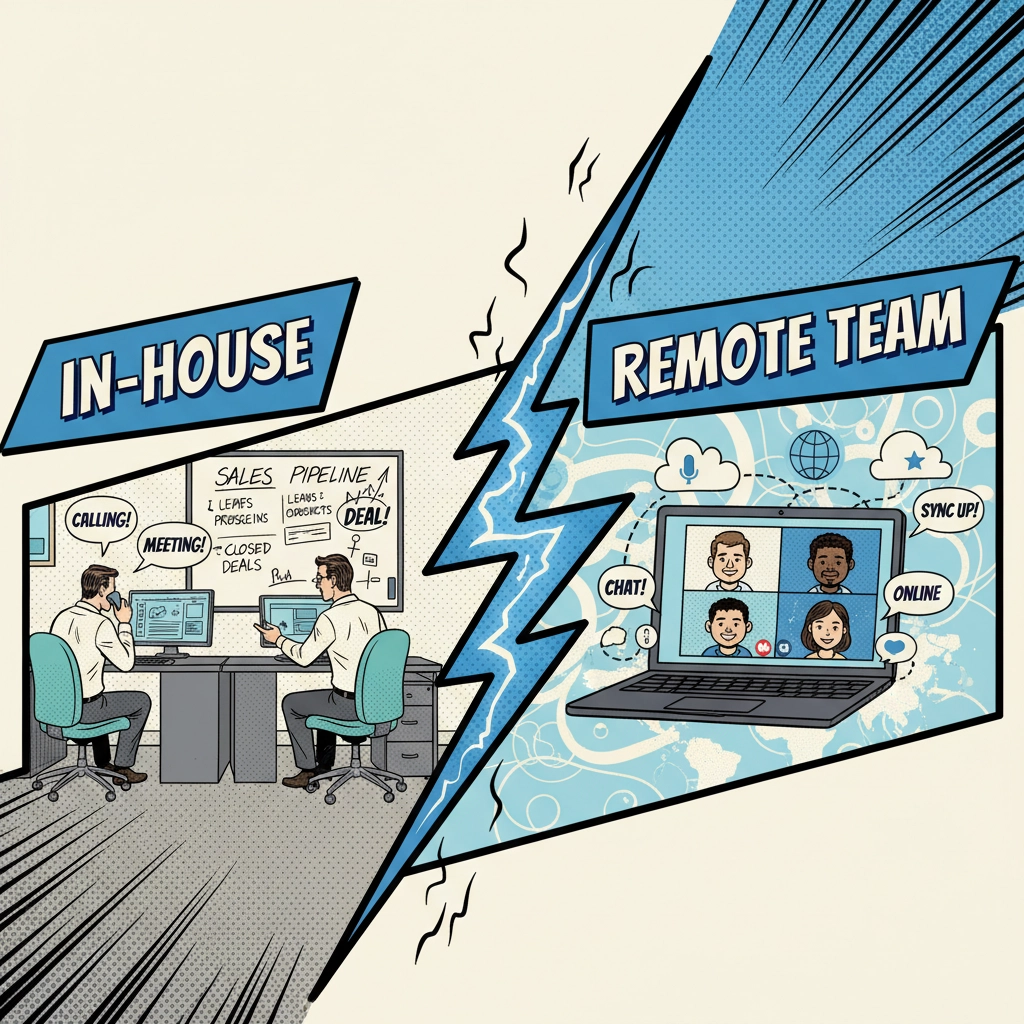
Remote Sales Teams vs In-House: Which Is Better For Your Growing Business in 2025?
The business world has flipped upside down, and nowhere is this more obvious than in how we build sales teams. If you're running a growing business in 2025, you're probably wrestling with a big question: should you hire an in-house sales team or go remote?
Here's the kicker – 71% of SaaS sales teams now work remotely at least part-time, compared to just 10-15% back in 2015. That's not just a trend; that's a complete revolution. And get this: 84% of companies using remote appointment setters report better ROI than traditional in-house teams.
So what's really going on here? Let's break down the numbers, the benefits, and the headaches of both approaches so you can make the smartest choice for your business.
The Remote Sales Revolution: Why Everyone's Making the Switch
Remote sales teams aren't just surviving – they're absolutely crushing it. Companies are saving 30-40% in operational costs compared to traditional in-house setups, and that's not even counting the productivity gains.

The Money Talk
When you ditch the office space, expensive equipment, and local hiring constraints, your budget suddenly has a lot more breathing room. Remote teams operate on performance-based models, meaning you're paying for results, not just warm bodies in chairs. 67% of companies with remote teams achieve their sales targets faster with significantly lower upfront investment.
Speed is Everything
Here's where remote teams really shine – time to market. While you're spending months recruiting, interviewing, and training in-house staff, outsourced remote teams can launch campaigns within weeks. In today's fast-moving business environment, that speed advantage can make or break your growth trajectory.
Access to Global Talent
Why limit yourself to the talent pool in your city when you can access specialists worldwide? Remote teams bring advanced sales technology, proven methodologies, and specialized expertise that would cost a fortune to develop internally.
But It's Not All Sunshine and Rainbows
Here's the reality check: 67% of sales managers find managing remote teams more challenging than they expected. Communication breakdowns happen. Collaboration gets tricky without face-to-face interaction. And let's be honest – remote team members might not live and breathe your brand the way in-house employees do.
In-House Teams: The Traditional Control Approach
There's still something to be said for having your sales team right there with you. In-house teams offer maximum control over your sales strategy, messaging, and company culture alignment.

The Control Factor
With in-house teams, you're the captain of your own ship. Every sales conversation, every strategy adjustment, every team meeting happens under your direct oversight. This control can be incredibly valuable for complex sales cycles or brand-critical interactions.
Brand Ambassadors
In-house team members become true brand ambassadors. They develop deep product expertise, understand your company's values inside and out, and can deliver genuinely personalized customer experiences. This authentic connection often translates to stronger customer relationships and higher lifetime value.
Team Chemistry
There's something magical about a tight-knit team working together in the same space. The spontaneous brainstorming sessions, the quick problem-solving conversations, the shared energy during big wins – this team chemistry can drive performance in ways that are hard to replicate remotely.
The Price of Control
Here's where in-house teams get expensive fast. You're looking at significant upfront investments in recruitment, training, tools, and infrastructure. Fixed costs remain constant whether your team is crushing targets or struggling to find leads. Plus, scaling up requires months of hiring and onboarding – time your competitors might not give you.
Head-to-Head Comparison: The Numbers Don't Lie
| Factor | Remote Teams | In-House Teams |
|---|---|---|
| Setup Cost | Minimal upfront investment | High recruitment and infrastructure costs |
| Time to Launch | 2-4 weeks | 3-6 months |
| Scalability | Instant scaling up or down | Slow, requires hiring cycles |
| Monthly Costs | 30-40% lower operational costs | Higher fixed costs regardless of performance |
| ROI Performance | 84% report better ROI | Traditional performance benchmarks |
| Management Time | Outsourced management | Full management responsibility |
| Brand Knowledge | Limited initially, grows over time | Deep from day one |
| Geographic Reach | Global talent and market access | Limited to local hiring pool |

Making the Right Choice for Your Growing Business
Go Remote When:
- Cash flow is tight and you need results without massive upfront investment
- Speed matters more than perfection – you need leads and revenue fast
- You're scaling rapidly and need flexible team expansion
- Management bandwidth is limited – you'd rather focus on running your business than managing salespeople
- Geographic expansion is part of your strategy
Stick with In-House When:
- Complex sales cycles require deep product knowledge and consultative selling
- Brand representation is critical to customer relationships
- You have stable cash flow for long-term team investment
- Strategic control over sales processes is non-negotiable
- Cross-functional collaboration is essential for sales success
The Hybrid Approach: Best of Both Worlds
Smart growing businesses in 2025 aren't choosing sides – they're getting creative. Many successful companies use remote teams for lead generation and appointment setting while maintaining a smaller in-house team for closing and account management.
This hybrid approach maximizes cost efficiency while maintaining strategic control over the most important customer interactions. You get the speed and cost benefits of remote teams with the brand alignment and expertise of in-house professionals.

The Bottom Line: Data Drives Decisions
The numbers are pretty clear – remote sales teams are delivering superior ROI for the majority of growing businesses. The 84% success rate and 30-40% cost savings aren't just statistics; they represent real companies achieving better results with less risk.
But here's the thing: the "best" choice depends entirely on your specific situation. If you're a fast-growing company that needs results yesterday, remote teams offer unbeatable speed and efficiency. If you're in a relationship-heavy industry where brand representation is everything, in-house might be worth the investment.
The businesses winning in 2025 are the ones making data-driven decisions based on their specific circumstances, not following outdated conventional wisdom. Whether you choose remote, in-house, or hybrid, the key is aligning your sales team structure with your growth goals, budget reality, and market demands.
Ready to explore how a sales and marketing system could transform your business growth? The future of sales is flexible, efficient, and results-focused – and it's happening right now.
