
Speed to Lead: How AI Do-ers Win the Job in the First 5 Minutes
A new lead comes in.
Maybe someone just searched for an emergency plumber. Maybe a clinic received a consultation request. Maybe a business owner clicked a Google ad and filled out a quote form.
At that exact moment, the prospect is interested. They are actively looking for a solution. They may have several browser tabs open and two or three competitors ready to answer.
Then the clock starts.
If your business responds in seconds, you have a real opportunity to start the conversation while their intent is high. If your team waits until later that afternoon: or tomorrow morning: the job may already belong to someone else.
This is the speed-to-lead advantage. And it is one of the biggest reasons agentic AI do-ers are changing how small and mid-sized businesses handle sales.
The First Five Minutes Are a Competitive Window
Speed-to-lead is simple: it measures how long it takes your business to provide a meaningful response after an inbound lead arrives.
That could be:
- A reply to a website form
- A response to a live chat message
- A follow-up after a Google Ads conversion
- A call-back request
- A social media inquiry
- A quote or consultation request
The response does not need to close the sale immediately. It needs to acknowledge the prospect, create momentum, and move the conversation forward.
Research and industry benchmarks have repeatedly shown that companies responding within five minutes are dramatically more likely to make contact and qualify an inbound lead than companies that wait 30 minutes or longer. Widely cited benchmarks report that a response within five minutes can make a business up to 100 times more likely to connect and 21 times more likely to qualify the opportunity compared with a much slower response.
The exact results vary by industry, offer, traffic source, and lead quality. But the underlying principle is consistent:
The longer a lead waits, the more likely their attention: and their business: moves somewhere else.
The Old “Call Back Tomorrow” Approach
Let’s look at a familiar example.
A local HVAC company is running Google Ads. At 8:47 p.m., a homeowner submits a form asking for help replacing a failing furnace.
The owner is finishing a job. The office manager has already left for the day. The form notification lands in an inbox that is checked periodically.
The company calls back the next morning at 8:30.
By then, the homeowner has already:
- Contacted three other HVAC companies
- Spoken with the first one that answered
- Booked an estimate
- Stopped searching
The HVAC company may have excellent technicians, competitive pricing, and dozens of happy customers. But none of that matters if the business never gets into the conversation.
This is where many SMBs misunderstand their marketing problem. They assume they need more leads, so they increase their advertising budget. But if existing leads are sitting unanswered, more traffic can simply create a larger backlog.
The real issue is not always lead volume.
Sometimes it is lead response time.
What AI Do-ers Do in Those First Few Seconds
Agentic AI do-ers are designed to take action, not just wait for a human to open a notification.
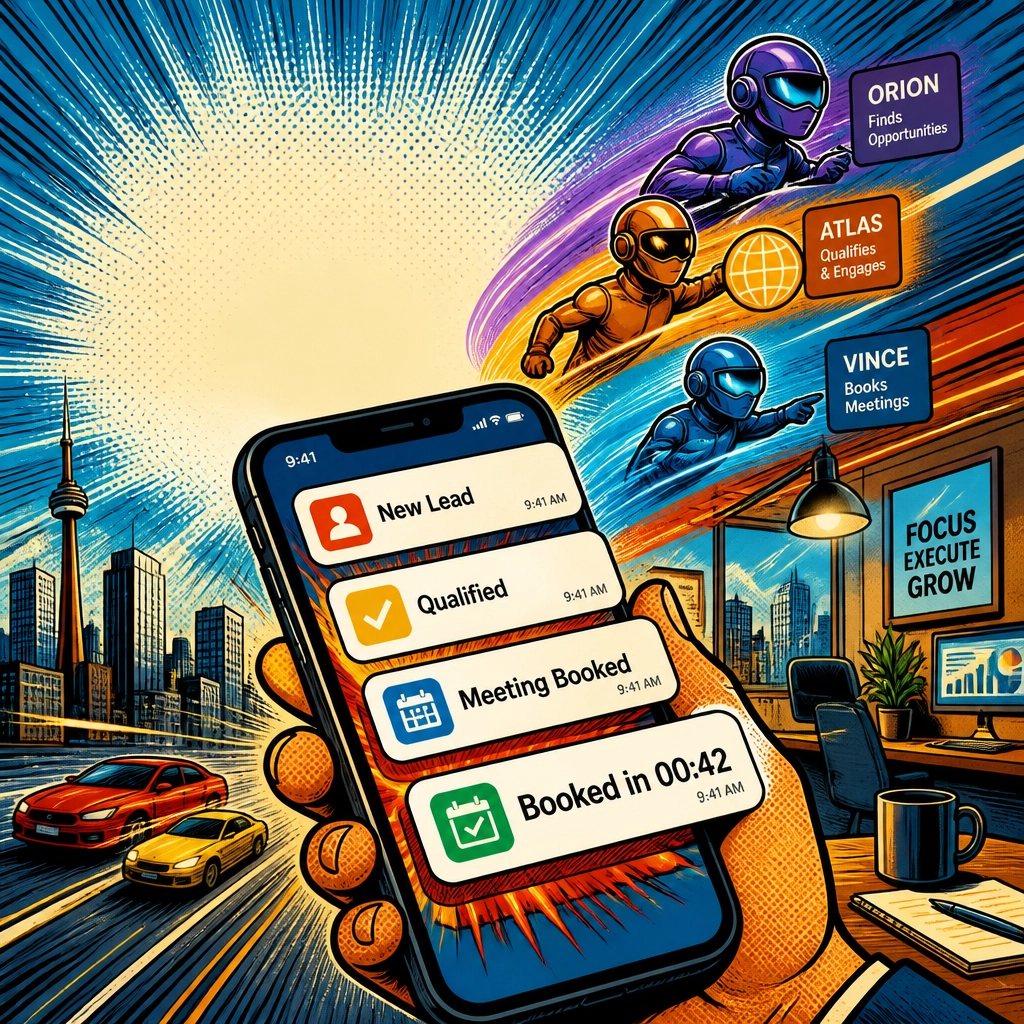
For Quality Lead Generation, Orion, Atlas, and Vince work as specialized AI employees inside a connected sales system.
Orion Starts the Conversation
Orion is the first mover.
When a new inquiry arrives, Orion can detect the lead, identify the source, and initiate a helpful response. The goal is not to send a generic “Thanks for contacting us” email and disappear.
The goal is to create a real next step.
For a home service business, Orion may acknowledge the request and ask what type of service is needed. For a clinic, Orion may ask whether the person is looking for an initial consultation, follow-up appointment, or specific treatment information.
For a B2B company, Orion can help identify the prospect’s business needs, timeline, and role in the buying process.
The key advantage is simple: the conversation starts while the prospect is still paying attention.
Atlas Qualifies and Nurtures the Lead
Once the initial conversation begins, Atlas helps organize the opportunity.
Atlas can ask qualification questions based on the business’s sales process, such as:
- What service are you looking for?
- Where are you located?
- How urgent is the project?
- What is your approximate timeline?
- Have you already received an estimate?
- Who is involved in the decision?
- What problem are you trying to solve?
This helps separate genuine opportunities from poor-fit or incomplete inquiries.
It also means the human team does not have to start every conversation from zero. By the time a qualified appointment reaches a salesperson, the important details are already captured.
If the prospect is not ready to book, Atlas can continue the follow-up process. A person who needs to “think about it” today may be ready next week. Without consistent nurturing, that opportunity is easy to forget.
You can read more about this qualification process in The Laser Focus Advantage: How AI Employees Qualify Leads Before You Ever Pick Up the Phone.
Vince Moves the Lead Toward a Meeting
Vince focuses on the conversion step.
When a prospect is qualified, Vince can help offer available appointment times, confirm contact information, and book the next conversation on the appropriate calendar.
That meeting could be:
- A roofing estimate
- A dental consultation
- A legal intake call
- A commercial recycling assessment
- A renovation discovery meeting
- A Google Ads strategy session
- A product demonstration
Instead of asking the prospect to wait for someone to call them back, the system can help them take action immediately.
That is a major shift. The business is no longer simply collecting leads. It is actively converting interest into scheduled opportunities.

A Better After-Hours Experience for Prospects
People do not only search for businesses during office hours.
They submit forms after dinner. They compare service providers on weekends. They request consultations late at night. They look for urgent help when the problem becomes impossible to ignore.
A lead arriving at 10:30 p.m. is not necessarily a low-quality lead. In some industries, it may be a very high-intent opportunity.
The challenge is that most small businesses cannot have a salesperson watching every inbox around the clock.
AI employees can provide that first layer of coverage while your human team is busy, offline, driving, serving customers, or sleeping. They can respond quickly, answer approved questions, qualify the inquiry, and book the next step without requiring a full overnight sales department.
That does not mean every conversation should remain fully automated. Complex, sensitive, or high-value situations can be escalated to a human team member.
The AI handles speed and consistency. Your people handle judgment, trust, relationships, and closing conversations that require a human touch.
For a deeper look at after-hours lead response, explore The 2 AM Advantage: How AI Employees Turn After-Hours Leads Into Revenue for SMBs.
Your Ads Are Only as Good as Your Follow-Up
A strong advertising campaign can put your business in front of the right audience.
A reliable PPC agency Vancouver businesses trust can help build campaigns around high-intent searches, local targeting, conversion tracking, and carefully structured landing pages. A Google Ads expert can help reduce wasted spend by improving keyword targeting, ad relevance, negative keywords, and campaign performance.
But advertising is only the beginning.
The complete path looks more like this:
Targeted ad → landing page → inbound inquiry → instant response → qualification → booked appointment → human sales conversation
If the final steps are slow or inconsistent, your marketing investment may produce activity without producing enough revenue.
This is why speed-to-lead should be treated as a measurable sales KPI: not an informal goal that depends on whether someone happens to notice a notification.
Track:
- Average first-response time
- Percentage of leads answered within five minutes
- Contact rate
- Qualification rate
- Appointment-booking rate
- Show-up rate
- Close rate by lead source
These numbers tell you whether your marketing is actually creating sales opportunities or simply filling a CRM.

The First Five Minutes Can Change the Entire Sales Process
The biggest benefit of speed-to-lead is not just winning one extra job.
It changes how the whole sales operation works.
Instead of starting each morning with a pile of unanswered forms, your team can begin with a prioritized list of qualified appointments. Instead of spending time asking repetitive questions, salespeople can review the conversation and focus on the prospect’s actual needs.
Instead of guessing which ad campaigns are working, your CRM can show which sources are creating booked meetings and closed business.
That is the difference between lead generation and a complete sales system.
A lead generation campaign brings attention to your business. An agentic AI sales system helps make sure that attention does not disappear.
Stop Chasing. Start Closing.
The first five minutes after an inbound inquiry are not a minor administrative detail. They are a critical competitive window.
Orion can start the conversation. Atlas can qualify and nurture the opportunity. Vince can help move the right prospect toward a booked meeting. Together, these AI employees keep your pipeline moving when your human team is busy or offline.
The goal is not to remove people from sales. It is to make sure your people spend more time on the opportunities that deserve their attention.
If your business is investing in advertising but still relying on “we’ll call them back tomorrow,” it may be time to rethink the system behind your leads.
Book a meeting with Quality Lead Generation to explore how AI do-ers can help your business respond faster, qualify more consistently, and turn more inbound interest into real appointments.
Your next customer may already be searching. The question is whether you will be the first business to answer.
Categories: Agentic AI, AI Sales Automation, Lead Generation, SMB Growth
