
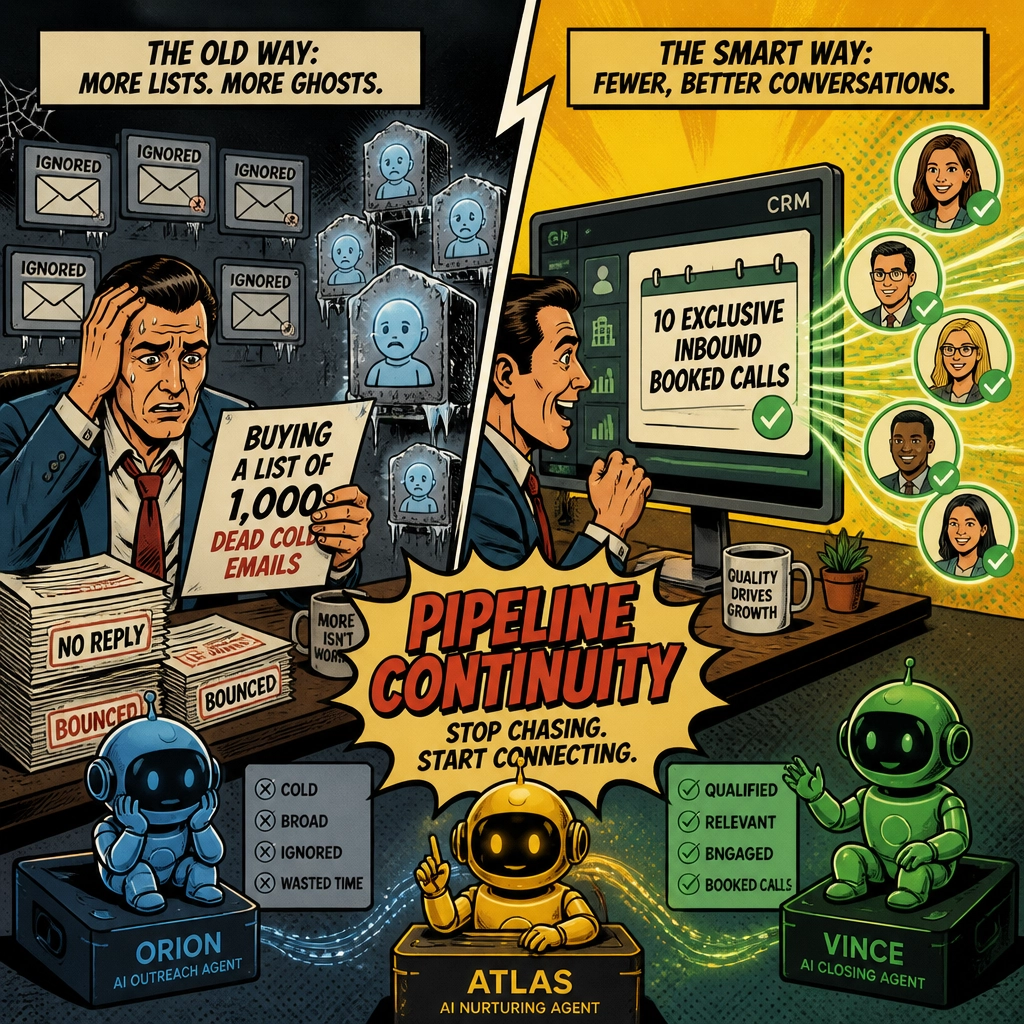
The Pipeline That Never Goes Quiet: How Agentic AI Ends the Feast-or-Famine Cycle
Excerpt: Feast-or-famine growth is usually a cadence problem. Agentic AI keeps your sales system creating, processing, and advancing opportunities every day: with humans stepping in when judgment matters most.
The feast-or-famine cycle is familiar: a busy month, a quiet month, then a frantic burst of prospecting to rebuild the pipeline. Business owners buy lead lists, launch short campaigns, or ask the sales team to “make more calls”: only to discover that inconsistent activity creates inconsistent revenue.
The answer is not simply more leads. It is pipeline continuity: a sales system that creates, responds to, qualifies, nurtures, and advances opportunities every day.
That is where Agentic AI changes the conversation. Instead of using AI only to write a message or summarize a call, businesses can deploy autonomous AI do-ers that execute approved workflows across the sales system. The result is an AI sales engine that keeps operating while your team serves customers, manages projects, or steps away for the evening.
From Sporadic Prospecting to a Daily Operating Cadence
Traditional sales automation waits for someone to start the sequence. An agentic system works from defined goals, CRM context, approved messaging, and clear guardrails.
At Quality Lead Generation, the workflow is organized around three specialized AI employees:
- Orion executes approved prospecting and outreach. It works from agreed target markets, customer profiles, channels, and messaging rules.
- Atlas responds to incoming activity, qualifies prospects, answers routine questions, and nurtures opportunities that are not ready to book immediately.
- Vince supports objection handling, meeting booking, conversation preparation, and the transition toward a human-led close.
This does not mean removing people from the sales process. It means giving people a system that reliably prepares the right conversation at the right time.

24/7 Execution With Human Judgment Built In
A strong AI lead generation system should not operate without boundaries. It should operate with them.
Guardrails can define who the system contacts, what it can say, which offers are approved, when it updates the CRM, and when it must escalate. Every interaction should be connected to relevant CRM context, including previous conversations, lead source, industry, company size, stated needs, and next steps.
The AI can manage repetitive, time-sensitive work such as:
- Initial outreach and follow-up
- Reply classification
- Basic qualification
- Lead nurturing
- Appointment scheduling
- CRM updates and reminders
- Conversation summaries and handoff notes
Human involvement remains essential for trust-heavy, strategic, complex, negotiated, or final closing conversations. When a prospect raises a sensitive objection, requests custom pricing, involves multiple decision-makers, or needs a high level of confidence, the system should prepare the human: not pretend to replace them.
This human handoff model is also consistent with broader guidance on agentic sales systems, where AI handles lower-risk workflow execution while people retain ownership of negotiation, strategic relationships, and final approvals. Learn more about agentic AI in sales.
A Practical Example
Imagine a commercial recycling company running Google Ads and LinkedIn outreach.
Orion identifies approved prospects and starts personalized outreach. A prospect replies asking whether the company handles a specific material. Atlas recognizes the buying signal, provides an approved response, asks a qualifying question, and offers a booking link.
If the prospect asks about contract terms, volume-based pricing, or a custom pickup arrangement, Vince flags the conversation. It prepares a concise summary, identifies the objection, recommends talking points, and helps book the meeting with the appropriate sales representative.
The system has not “closed the deal” on its own. It has prevented the opportunity from sitting untouched in an inbox and helped the human enter the conversation prepared.

Implementation Checklist for a Continuous Pipeline
Before launching an agentic workflow, define:
- Your ideal customer profile: industries, locations, company sizes, and decision-makers.
- Approved actions: what Orion, Atlas, and Vince may send, change, schedule, or recommend.
- Escalation triggers: pricing questions, legal issues, complex objections, high-value accounts, and final negotiations.
- CRM requirements: required fields, lifecycle stages, lead sources, notes, and next actions.
- Success measures: response time, qualified conversations, booked meetings, pipeline velocity, and revenue: not just message volume.
- Human ownership: who receives each handoff and how quickly they are expected to respond.
Quality Lead Generation builds these connected systems through done-for-you digital marketing, conversion-focused funnels, CRM setup, AI employee customization, and outsourced sales services. Whether you need a ppc agency vancouver businesses can rely on, a google ads expert, or a complete sales operation, the goal is the same: create a dependable operating cadence that keeps opportunities moving.
Ready to replace sporadic prospecting with a sales system that works every day? Book a meeting with Quality Lead Generation.
Categories: Agentic AI, Sales Automation, Sales Outsourcing
Suggested slug: agentic-ai-pipeline-continuity-feast-famine-cycle
SEO title: Agentic AI: End the Feast-or-Famine Sales Cycle
Meta description: Learn how Agentic AI keeps your pipeline moving 24/7 with autonomous AI do-ers, CRM context, guardrails, and human sales handoffs.
Hashtags: #AgenticAI #SalesAutomation #AIEmployees #LeadGeneration #SalesOutsourcing #SmallBusinessGrowth
BLOG_POST
