
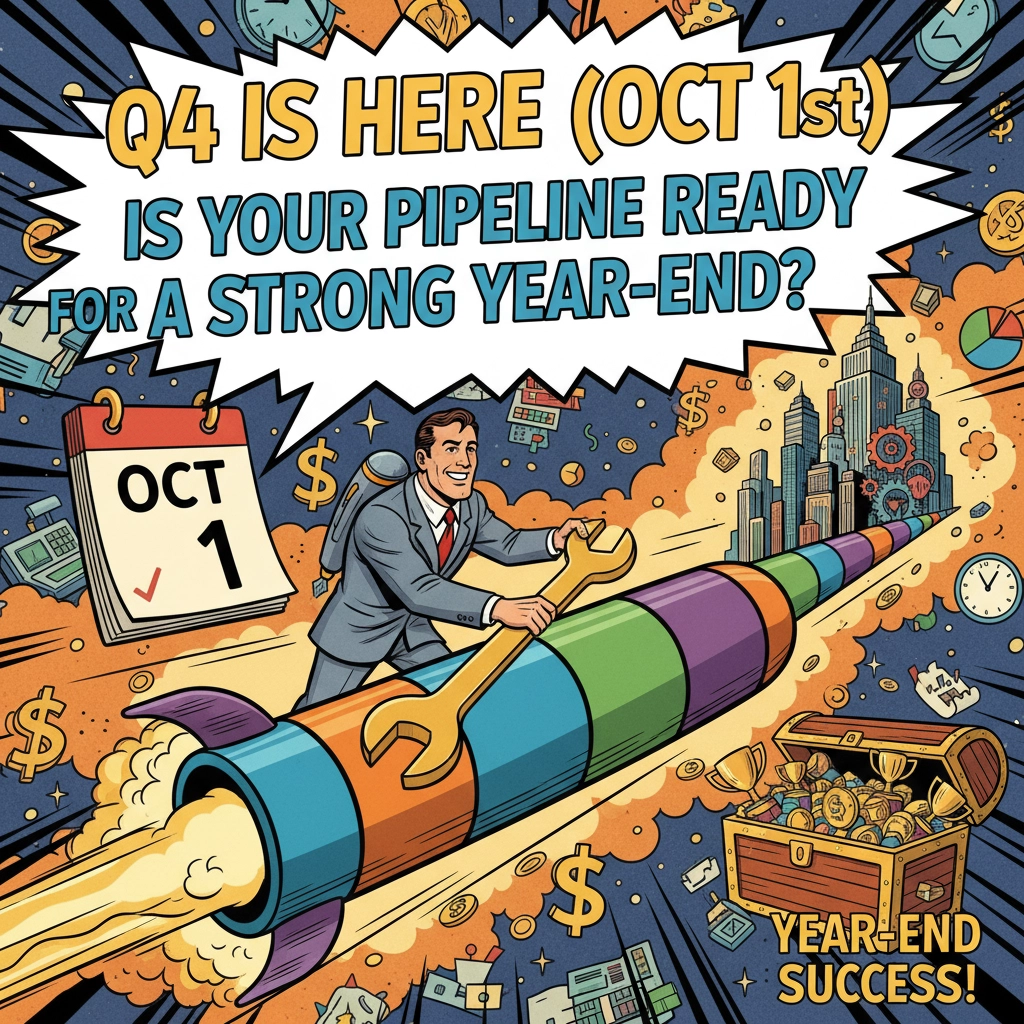
Q4 is Here (Oct 1st): Is Your Pipeline Ready for a Strong Year-End?
October 1st just hit, which means we're officially in Q4 territory. If you're like most business owners, you're probably staring at your calendar wondering where the heck 2025 went and whether your sales pipeline is actually ready to carry you through to a strong finish.
Here's the thing: Q4 can either be your victory lap or your scrambling-to-catch-up nightmare. The difference? How well you've prepared your pipeline and how smart you get about managing it over the next 90 days.
Take a Hard Look at What's Actually in Your Pipeline
Time for some tough love. That deal you've been "nurturing" since July? The one where the contact hasn't returned your calls in three weeks? Yeah, that's not closing this year.
The first step to Q4 success is conducting what I like to call a "pipeline reality check." Block out a few hours (seriously, put it on your calendar) and go through every single opportunity in your CRM. Ask yourself these brutal but necessary questions:
- Has this prospect engaged meaningfully in the last 30 days?
- Do I have a clear next step scheduled?
- Is there actual budget allocated for this purchase?
- Can this realistically close before December 31st?
If you're getting "no" answers, it's time to either push these deals into your Q1 pipeline or mark them as dead. I know it hurts, but chasing ghost deals in Q4 is like trying to catch smoke – you'll exhaust yourself and have nothing to show for it.

Focus on High-Probability Wins
With limited time left in the year, you need to be ruthlessly strategic about where you spend your energy. The opportunities that deserve your attention in Q4 are the ones where:
- You've already completed 70% or more of your sales process
- There's confirmed executive sponsorship (not just interest from a middle manager)
- Budget has been verified and approved
- You understand their procurement process and timeline
These are your "must-win" deals – the ones that can realistically close before the holiday shutdown kicks in. Everything else? That's your Q1 pipeline in the making.
Think about it this way: would you rather chase 20 maybes and close 2, or focus intensely on 8 highly-qualified opportunities and close 6? The math is pretty clear.
Set Up Your Pipeline Segments
Here's a framework that actually works. Divide your entire pipeline into three clear buckets:
Bucket 1: Must Close (December targets)
These are deals that have real momentum, clear timelines, and decision-makers who are ready to move. Spend about 70% of your team's time here.
Bucket 2: Early Q1 (January-February targets)
Solid opportunities that are progressing but won't realistically close this year due to budget cycles, approval processes, or timing. Don't abandon these – just manage expectations and stay warm.
Bucket 3: Pipeline Building (Q1 and beyond)
New prospects and early-stage opportunities. Dedicate about 30% of your time here so you're not starting from scratch in January.
This segmentation isn't just useful for Q4 – it's a year-round strategy that keeps your pipeline healthy and predictable.

The Q4 Closing Accelerator Strategy
Want to speed things up without being pushy? Here are some tactics that work:
Create urgency without being fake about it. Year-end budget cycles, tax considerations, and implementation timelines are all legitimate reasons why December 31st matters. Use them.
Offer Q4-specific incentives. Maybe it's extended implementation support, locked-in pricing for 2026, or bonus services. Give prospects a real reason to move now instead of January.
Simplify your closing process. Remove friction wherever possible. Can you accept electronic signatures? Offer flexible payment terms? Make the "yes" as easy as possible to say.
Don't Forget About Next Year
Here's what separates the pros from the amateurs: while you're focused on closing Q4 deals, you're also building your Q1 pipeline. The worst thing you can do is sprint through December, hit your numbers, and then face a completely empty pipeline on January 2nd.
Keep feeding the top of your funnel with consistent outreach, content marketing, and relationship building. Your Q1 self will thank you for not leaving them with a pipeline that looks like a ghost town.
This is where having a systematic approach really pays off. If you're managing your own prospecting while trying to close deals, something's going to suffer. That's exactly why businesses work with outsourced sales teams – they can keep the pipeline full while you focus on closing.

Common Q4 Pipeline Mistakes to Avoid
Mistake #1: Chasing everything instead of prioritizing
I see this constantly. Business owners try to work every deal in their pipeline instead of focusing on the ones that can actually close. It's the business equivalent of trying to catch every fish in the pond instead of landing the big ones that are already on your hook.
Mistake #2: Ignoring lead quality in favor of lead quantity
Q4 pressure makes people desperate, and desperate people make bad decisions. Resist the urge to chase every inquiry that comes in. A few high-quality, well-qualified prospects will always outperform a dozen tire-kickers.
Mistake #3: Forgetting about follow-up systems
Your CRM should be your best friend right now. Set up automated sequences to keep prospects warm, schedule regular check-ins, and don't let deals fall through the cracks just because things get busy.
The Real Secret to Q4 Success
Want to know the truth? The businesses that crush Q4 aren't the ones scrambling in October. They're the ones who've been consistently building and managing their pipeline all year long.
But if you're reading this and thinking "well, that ship has sailed," don't panic. You've still got 90 days to make things happen, and that's plenty of time if you're smart about it.
The key is being honest about where you are, realistic about what you can achieve, and strategic about how you deploy your resources. Focus on the deals that can actually close, keep building for next year, and remember that a strong Q4 isn't just about hitting numbers – it's about setting yourself up for momentum heading into 2026.
Your pipeline health directly impacts your business growth, cash flow, and stress levels. If you're finding it hard to manage both closing current deals and building future pipeline, it might be time to consider getting some help with your sales and marketing systems.
The clock's ticking, but you've got this. Time to turn Q4 into your victory lap.
Blog Post 2: 3 Costly Mistakes Businesses Make with Google Ads (And How to Fix Them)

Google Ads can be a goldmine for lead generation – or a money pit that drains your budget faster than you can say "click fraud." The difference usually comes down to avoiding three critical mistakes that I see businesses make over and over again.
After managing hundreds of Google Ads campaigns, I can tell you that most businesses are leaving serious money on the table. The good news? These mistakes are totally fixable once you know what to look for.
Mistake #1: Terrible Keyword Strategy (AKA Throwing Darts Blindfolded)
Here's the biggest mistake I see: businesses bid on keywords without understanding what they actually mean or who's searching for them. They'll target broad terms like "marketing services" and wonder why they're getting clicks from people looking for entry-level marketing jobs.
The Problem: You're paying for traffic that has zero intention of buying from you.
The Fix: Get specific with your keyword targeting. Instead of "plumber," try "emergency plumber near me" or "residential plumbing repair." Instead of "lawyer," go for "personal injury attorney [your city]."
Long-tail keywords might get fewer searches, but they convert like crazy because the intent is crystal clear. Someone searching for "best CRM for real estate agents" is way more likely to buy than someone just searching "CRM."

Mistake #2: Ignoring Negative Keywords (The Silent Budget Killer)
This one's subtle but deadly. Negative keywords are the terms you DON'T want to show up for, and most businesses completely ignore them. Then they wonder why their "digital marketing" ads are showing up for people searching "digital marketing jobs" or "free digital marketing course."
The Problem: You're wasting ad spend on completely irrelevant searches.
The Fix: Build a robust negative keyword list from day one. Common negatives include: free, jobs, career, salary, course, training, DIY, how to, cheap. Monitor your search terms report weekly and add negatives as you spot irrelevant queries.
I've seen businesses cut their cost-per-click by 40% just by adding proper negative keywords. That's money that goes straight back into your pocket or into reaching actual prospects.
Mistake #3: Sending Traffic to Your Homepage (The Conversion Killer)
This one makes me want to pull my hair out. You create a targeted ad for "emergency HVAC repair," someone clicks it, and then… you send them to your generic homepage that talks about your company history and lists all 47 services you offer.
The Problem: There's a massive disconnect between what the ad promised and what the landing page delivers.
The Fix: Create dedicated landing pages that match your ad messaging. If your ad is about emergency HVAC repair, your landing page should be 100% focused on emergency HVAC repair – the problem, your solution, social proof, and a clear call-to-action.
The messaging should flow seamlessly: Ad → Landing Page → Conversion. No detours, no distractions, no asking people to figure out what to do next.

The Hidden Mistake: Not Tracking What Actually Matters
Here's a bonus mistake that ties everything together: measuring the wrong metrics. I see businesses get excited about impressions and clicks while completely ignoring leads and sales.
Impressions don't pay the bills. Clicks don't either. What matters is how many qualified leads you're generating and how many of those turn into customers.
Set up proper conversion tracking from day one. Know your cost per lead, your lead-to-customer conversion rate, and your customer lifetime value. These metrics will tell you whether your Google Ads investment is actually profitable.
Quick Wins You Can Implement Today
Audit Your Current Keywords: Log into your Google Ads account and check your search terms report. What are people actually searching for when they click your ads? Add irrelevant terms as negatives and double down on the ones that convert.
Review Your Ad-to-Landing Page Flow: Click through your own ads. Is there a clear connection between what you promised in the ad and what people see on your landing page?
Set Up Proper Tracking: Make sure you're tracking leads, not just clicks. Use Google Analytics goals, conversion tracking, and call tracking if phone calls are important for your business.
The truth is, Google Ads isn't complicated – but it does require attention to detail and ongoing optimization. The businesses that succeed are the ones who treat it like the direct response marketing channel it is, not like billboard advertising.
If you're struggling to make Google Ads profitable, the problem usually isn't the platform – it's the strategy. Fix these three mistakes, and you'll be amazed at how much better your campaigns perform.
Blog Post 3: Your Sales Team is Great at Closing, Not Prospecting. Let Them Do What They Do Best.
I need to tell you something that might sting a little: making your best closers spend half their day cold calling is like asking a Formula 1 driver to deliver pizza. They can do it, but it's a massive waste of their talent.
Your sales superstars didn't get good at closing deals by being great at prospecting. They got good by understanding buyer psychology, handling objections, and knowing exactly when to ask for the signature. So why are we forcing them to spend 3-4 hours a day dialing for dollars?
The Prospecting vs. Closing Skill Gap
Here's what most business owners don't realize: prospecting and closing are completely different skill sets. It's like expecting your best chef to also be great at grocery shopping and restaurant marketing. Related? Sure. The same skillset? Not even close.
Great prospectors are researchers, pattern recognizers, and masters of initial engagement. They know how to identify potential buyers, craft compelling outreach, and start conversations with complete strangers.
Great closers are psychologists, negotiators, and trust builders. They know how to guide qualified prospects through a buying decision, handle complex objections, and create urgency without being pushy.
The problem is, most businesses expect their sales team to be world-class at both. The result? Your closers are mediocre prospectors, and they're spending way too much time on activities that don't play to their strengths.

The Hidden Cost of Forcing Closers to Prospect
Let's do some quick math. Say your top salesperson closes deals at a 35% rate when they're talking to qualified prospects. But when they're prospecting, they're only able to generate 2-3 qualified conversations per day instead of having 6-8 conversations with pre-qualified leads.
Scenario A (Current State):
- 4 hours prospecting = 2 qualified conversations
- 4 hours closing = 2 more conversations
- Total: 4 conversations, 35% close rate = 1.4 deals
Scenario B (Optimized State):
- 8 hours closing pre-qualified leads = 8 conversations
- 35% close rate = 2.8 deals
Same salesperson, same skills, double the results. The only difference? They're spending their time on what they do best instead of what they do adequately.
What Your Closers Actually Want to Be Doing
I've talked to hundreds of salespeople, and here's what the good ones tell me: they want to be solving problems, not chasing prospects. They want to be having strategic conversations about implementation, ROI, and business impact – not leaving voicemails for people who never called them back.
Your best salespeople are relationship builders and consultants. They shine when they're:
- Understanding complex business challenges
- Presenting tailored solutions
- Handling sophisticated objections
- Negotiating terms and pricing
- Guiding prospects through decision-making processes
They don't light up when they're:
- Cold calling from purchased lists
- Sending generic LinkedIn messages
- Researching prospects they may never talk to
- Following up on unqualified leads
- Managing prospecting databases
The Solution: Separate Prospecting from Closing
Smart businesses have figured out that the answer isn't training closers to be better prospectors. The answer is separating these functions entirely.
Option 1: Hire dedicated prospecting talent
Build an internal team of people who love the hunt. These are different people than your closers – they're energized by starting conversations, not finishing them.
Option 2: Outsource your prospecting
Work with a specialized team that lives and breathes lead generation. They handle the research, outreach, and qualification, then hand off sales-ready prospects to your closers.
Option 3: Use technology to automate the top of funnel
Implement systems that generate leads automatically so your sales team can focus purely on converting qualified prospects.

The Results Speak for Themselves
I've seen this transformation dozens of times, and the results are consistently dramatic:
Case Study: Local Construction Company
- Before: 3 salespeople spending 50% of time prospecting, closing 8 deals/month
- After: Same 3 salespeople focused purely on closing, with outsourced prospecting
- Result: 18 deals/month within 90 days
Case Study: Professional Services Firm
- Before: 2 partners doing their own business development, landing 3-4 new clients/month
- After: Dedicated prospecting system feeding qualified opportunities
- Result: 9-11 new clients/month, partners focused on delivery and closing
The pattern is always the same: when closers get to focus on closing, everything improves. Deal quality goes up, close rates increase, and your best salespeople actually enjoy their jobs again.
Making the Transition
If you're ready to let your closers do what they do best, here's how to make it happen:
Step 1: Audit your current sales activities
Track how your team actually spends their time for two weeks. How much time goes to prospecting vs. closing? What's the quality difference in their performance across these activities?
Step 2: Calculate the opportunity cost
What would happen if your best closer could spend 100% of their time talking to pre-qualified prospects instead of 50%? Run the numbers – they're usually shocking.
Step 3: Test a hybrid approach
Start by taking prospecting off one person's plate for a month. Have them focus purely on closing while someone else (internal or external) feeds them qualified leads. Measure the results.
Step 4: Scale what works
If the test works (and it usually does), systematically transition your entire sales function to this model.
The Bottom Line
Your sales team's job is to turn qualified prospects into customers, not to find those prospects in the first place. When you let specialists handle each part of the process, everyone performs at their highest level.
Stop asking your closers to be mediocre prospectors. Let them be world-class closers instead. Your revenue will thank you, and so will your sales team.
If you're ready to explore what this could look like for your business, it might be worth having a conversation about how outsourced sales teams can transform your results while letting your internal team focus on what they do best.
